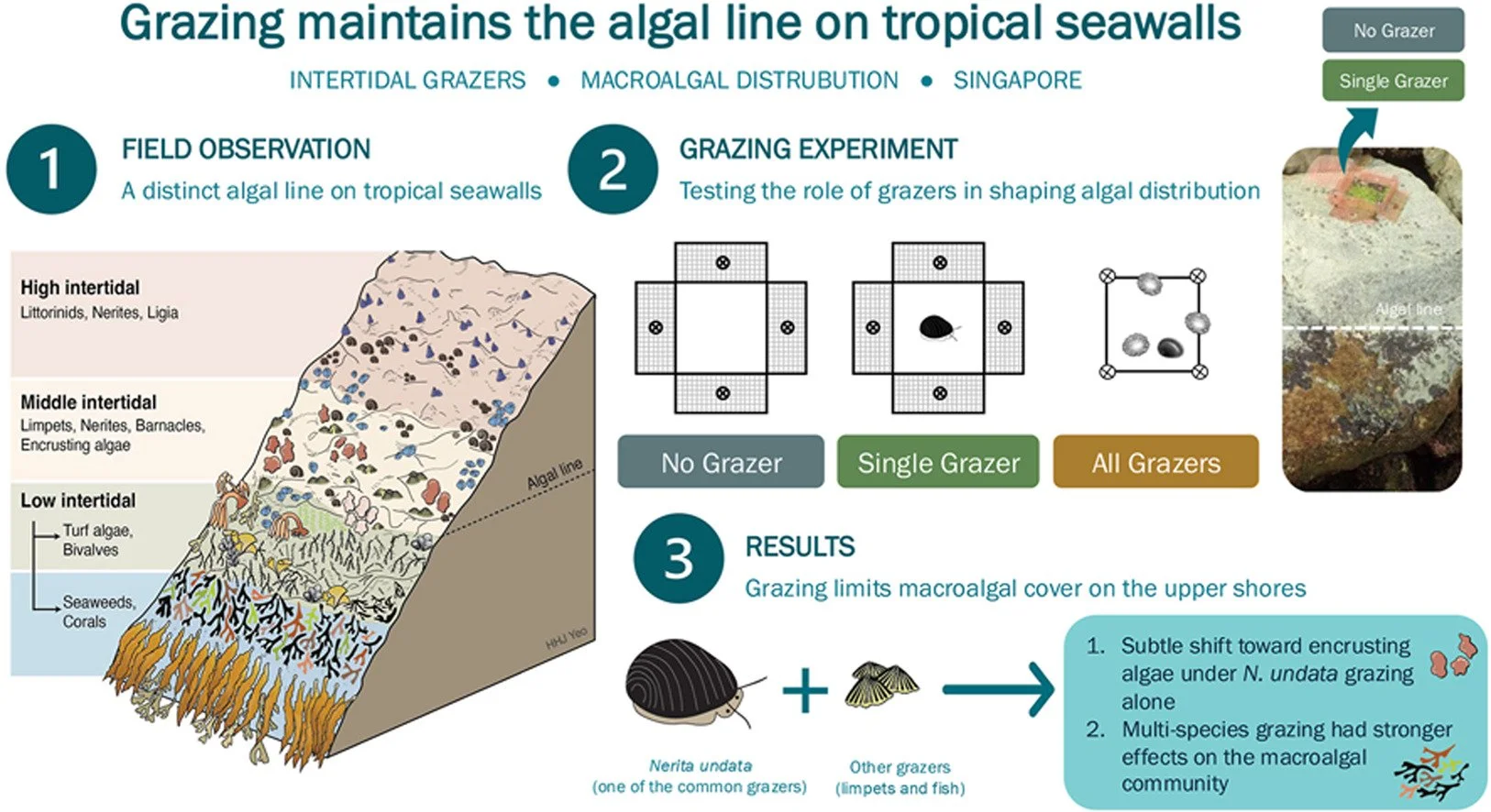
Organisms on rocky and other hard intertidal shores often occur in distinct horizontal bands, a pattern known as zonation. Physical stress is generally considered to set the upper limits of their distribution, while biological interactions often become more important lower on the shore. On Singapore’s steep granite seawalls, macroalgae form a distinct band that ends abruptly against seemingly bare rock. However, the relative roles of physical factors and grazing in maintaining this boundary were unclear.
In a new paper led by Hannah Yeo, we used a manipulative field experiment to test the effects of grazing by the wider community and by Nerita undata alone. After six months, turf algae had extended around half a metre above the usual boundary in plots where grazers were excluded. This shows that physical conditions alone do not determine the position of the boundary: grazing pressure does also limit how far the macroalgal band extends up the shore. Despite being one of the most abundant grazers on Singapore’s seawalls, Nerita undata only partly constrained this expansion at its natural mean density. The apparently bare rock above the macroalgal band may therefore reflect the combined grazing pressure of the wider community, possibly including rabbitfishes (Siganus), rather than low primary productivity.
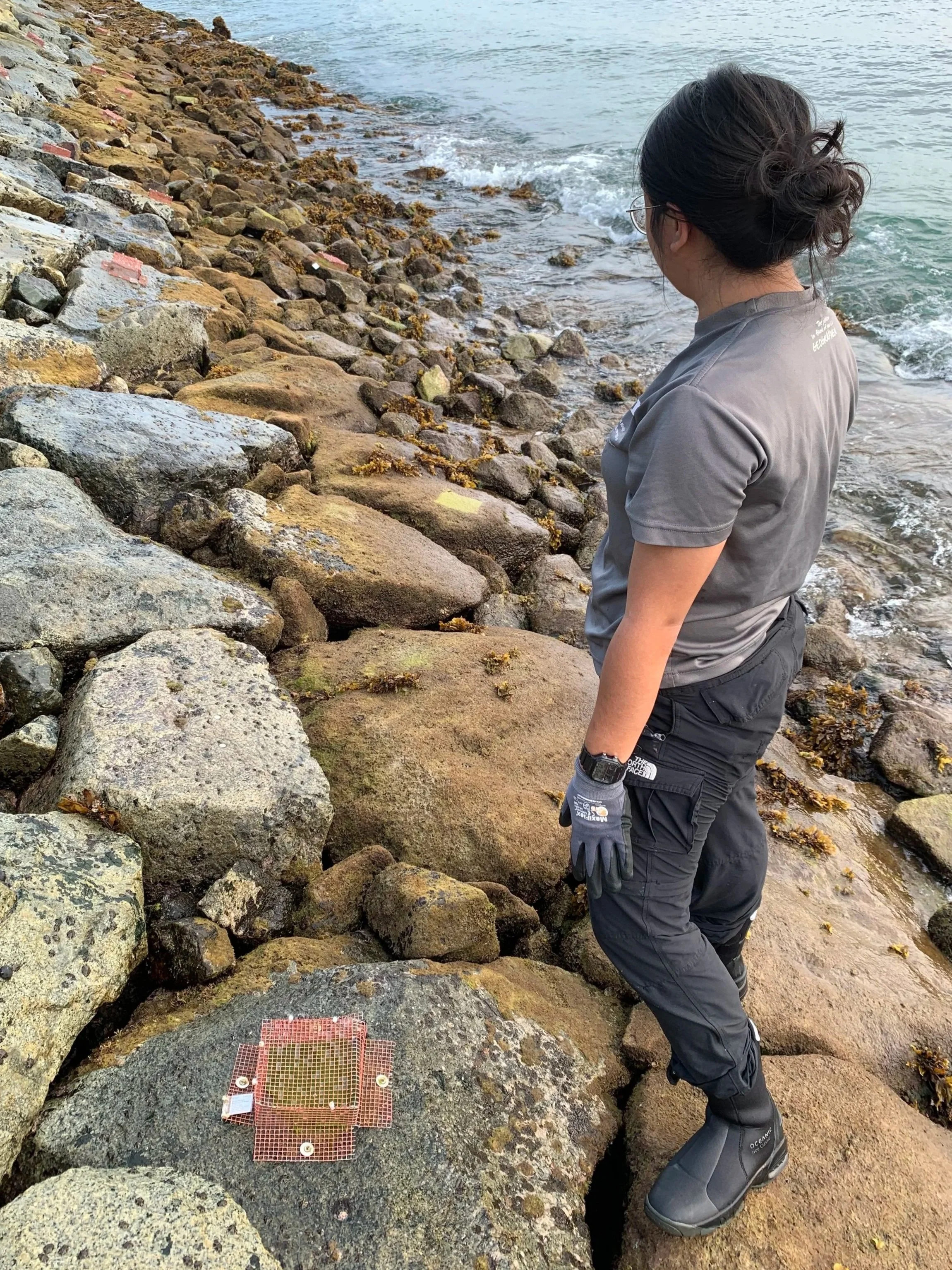
Hannah Yeo with the enclosures used in her grazing experiment on Sentosa Island, Singapore. Photo: Lynette Loke, 2019.